Be Like Baxter
Three simple words, and why the founder built all of this around them. Start here if you have five minutes.
Read & Learn
The idea is simple enough to fit on a bumper sticker. It is the living-with-it part that takes some reading.

The short version
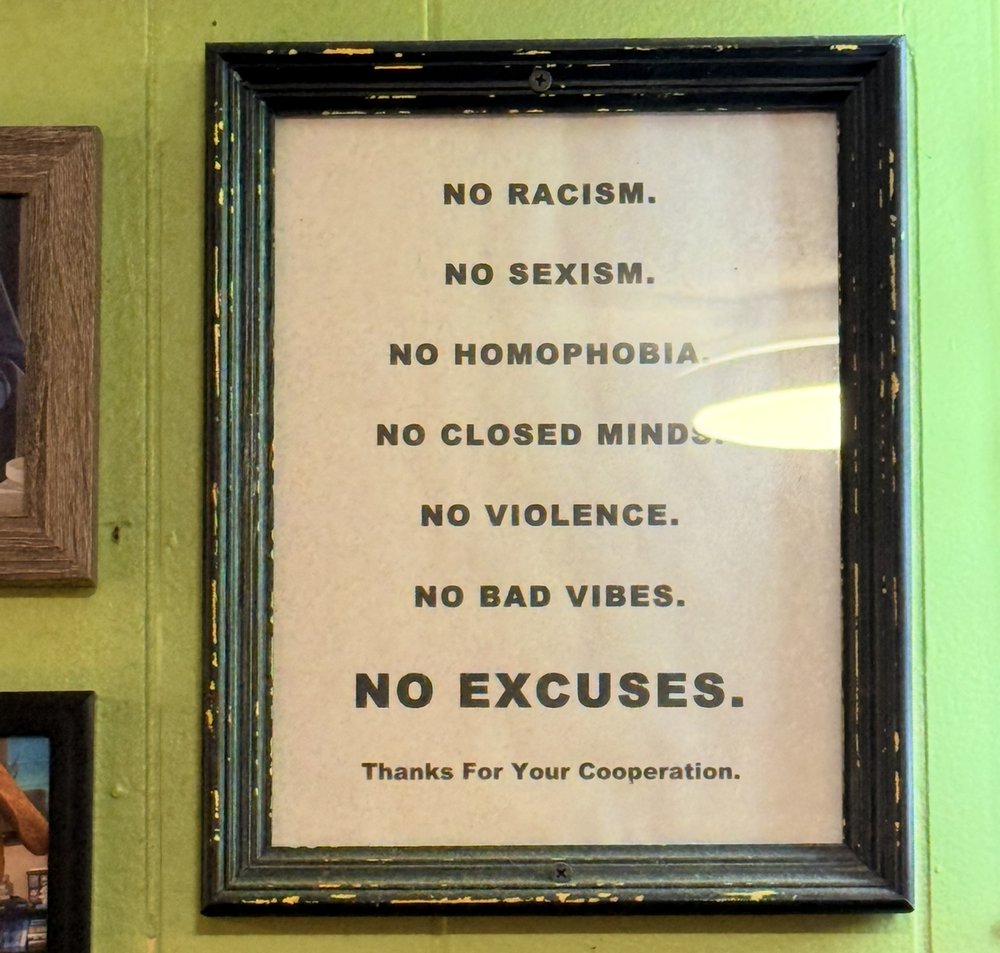
This is hanging on a wall in a restaurant. Nobody workshopped it. Somebody just got tired of the alternative, printed it, and put a frame around it.
It is the same idea as a dog who jumped on everybody without checking first — written out as house rules. Baxter never needed the list. The rest of us occasionally do.
Where to begin
Everything worth reading on this site is one click from here.
Three simple words, and why the founder built all of this around them. Start here if you have five minutes.
The longer manifesto — who Baxter was, what the “Wheaten Greeting” actually was, and what it asks of the rest of us.
Short pieces on labels, judgement, and the half second before you decide about somebody. Readers write these too.
One thing this week
Read one book, watch one film, or go to one event this month that teaches you something about a group of people you don't belong to. Take somebody with you.
After The President's Initiative on Race
Twenty good ideas at once is a way of doing none of them. Pick this one up, carry it for a week, and let it change the next conversation you have.
The library
None of this is ours, and that is the point. A psychologist, a foundation, a children’s charity and a President’s commission — all reprinted here in full, in their own words, with permission. Every one of them says what the manifesto says, only with the research behind it.
The President's Initiative on Race · The White House · reprinted in full (public domain)
“Many of them told us that they would welcome concrete advice about what they should do.”
— The President's Initiative on Race
The full text of the ten actions published by The President's Initiative on Race — a public-domain list of concrete, everyday things one person can actually do.
Try this Read a book. Learn one person's story. Speak up when something is said, even when it is not aimed at you.
Rick Hanson, Ph.D. · reprinted in full, with permission
“Accepting people does not itself mean agreeing with them, approving of them, waiving your own rights.”
— Rick Hanson, Ph.D.
In what ways do you wish that people were different? A psychologist's short practice for accepting somebody completely — which is not the same as agreeing with them.
Try this Pick one person who bothers you. Say "I accept you completely." Notice what comes up.
Terry Schmitz · Founder, The Conover Company · reprinted in full, with permission
“If they could do better, they would.”
— Terry Schmitz
Five strategies for accepting other people, from the founder of The Conover Company: stop controlling feelings, allow difference, give thoughtful advice, don't judge quickly, and try not to compare.
Try this Next time you meet your polar opposite, get to know them instead of avoiding them.
ANANIAS Foundation · reprinted in full, with permission
“Our mistrust of others is really fear.”
— ANANIAS Foundation
Why difference makes us uneasy, what sits underneath the unease, and why acceptance is not the same as agreement — from the ANANIAS Foundation.
Try this Acceptance is not agreement. You do your thing, I'll do mine, and neither of us has to win.
Sarah Ferguson · UNICEF USA · reprinted in full, with permission
“Prejudice and hate are not innate. They are learned behaviors—and they can be unlearned.”
— Sarah Ferguson
Celebrate other cultures, call out hate speech, teach children kindness, act in solidarity, and support human rights organizations — five practical ways from UNICEF USA.
Try this Talk to children about differences. Silence teaches them something too.
Latest from the blog
Five practical ways to push back against racism and prejudice in ordinary life — celebrating, speaking up, teaching children, standing with people, and backing the organisations that do the work.
Why difference makes us uneasy, what is actually going on underneath it, and the daughter who does not vote the way her father does.
Nobody chooses to be judged, and nobody enjoys being managed. Five habits that make you easier to be around — including the one that quietly does the most damage.
Add to the shelf
We only list things we have actually read. If you know a book, an organisation or a piece of writing that belongs on this shelf, tell us — that is exactly the kind of note we like getting.